Whether you are recruiting talent or relocating to Canada, we support you throughout the entire process—from connecting with approved employers to managing your permanent residence application.
Canada introduced Bill C-3 on December 15, 2025, removing key limits on citizenship by descent and restoring rights for many people born outside Canada. For families in the United States and worldwide, the question may no longer be whether they qualify for Canadian citizenship — but whether they already have it.
On December 15, 2025, a major shift in Canadian nationality law quietly took effect with the implementation of Bill C-3, an amendment to Canada’s Citizenship Act.
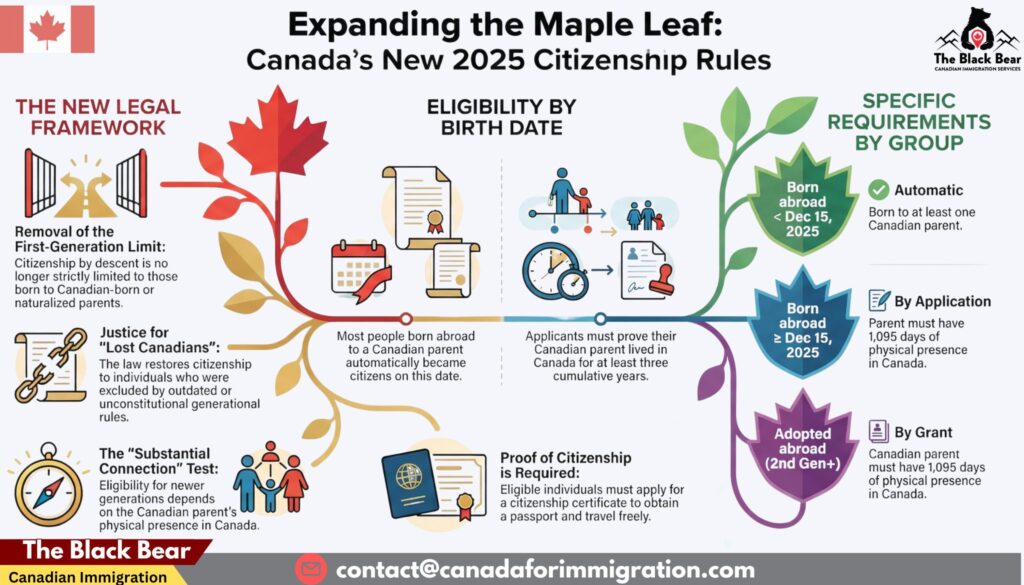
For decades, Canadian citizenship by descent was limited by a strict generational rule. If a Canadian citizen was born outside Canada and later had children abroad, those children were often excluded from citizenship eligibility.
This “first-generation limit” created significant barriers for global Canadian families who maintained deep cultural and personal ties to Canada.
Following a landmark ruling by the Ontario Superior Court of Justice in December 2023, the federal government introduced Bill C-3 to replace this rigid limitation with a more inclusive framework.
The result is a historic restructuring of citizenship law that restores access for many individuals previously excluded.
For decades, Canadian citizenship by descent generally stopped at the first generation born outside Canada.
This meant that if your Canadian parent was themselves born abroad, your eligibility for citizenship was typically denied under the law.
In December 2023, the Ontario Superior Court of Justice declared this rule unconstitutional in key cases. The federal government chose not to appeal the decision.
Instead, it introduced Bill C-3 to replace the generational barrier with a modern citizenship framework that reflects today’s globally mobile families.
This reform recognizes that Canadian identity and connection do not disappear simply because families live across borders.
The most transformative aspect of Bill C-3 is its retroactive effect.
If you were born or adopted outside Canada in the second generation or later before December 15, 2025, you may have automatically become a Canadian citizen when the law came into force.
This is not an immigration pathway. It is a legal recognition of citizenship status.
However, even if citizenship exists by law, it must still be documented.
To exercise citizenship rights — including applying for a passport — individuals must apply for a Citizenship Certificate as formal proof.
The Black Bear Canadian Immigration Consulting is ready to guide you.
Explore how Canada’s 2025 citizenship reforms expand eligibility for families born abroad and restore rights to previously excluded generations.
For children born or adopted outside Canada after December 15, 2025, citizenship can still pass beyond the first generation.
However, a new “Substantial Connection” requirement applies.
The Canadian parent must demonstrate at least 1,095 days (three cumulative years) of physical presence in Canada before the child’s birth or adoption.
This rule ensures that citizenship reflects a meaningful connection to Canada while preserving generational continuity.
In an era of geopolitical uncertainty, citizenship is not simply identity — it is a strategic asset.
Citizenship by descent cases are highly technical and require careful documentation.
Errors or incomplete filings can result in delays or refusals.
Citizenship status may exist by law, but it must be proven through documentation.
Listen to our immigration professionals discuss the realities of humanitarian immigration applications and the legal considerations involved.
At The Black Bear Canadian Immigration Consulting, we provide structured advisory services for individuals exploring eligibility under Bill C-3.
Our services include:
• Comprehensive citizenship lineage audits
• Eligibility risk assessments
• Substantial connection analysis
• Citizenship Certificate application preparation
• Cross-border advisory for Canada–U.S. families
We approach these cases not as administrative paperwork, but as strategic citizenship planning.
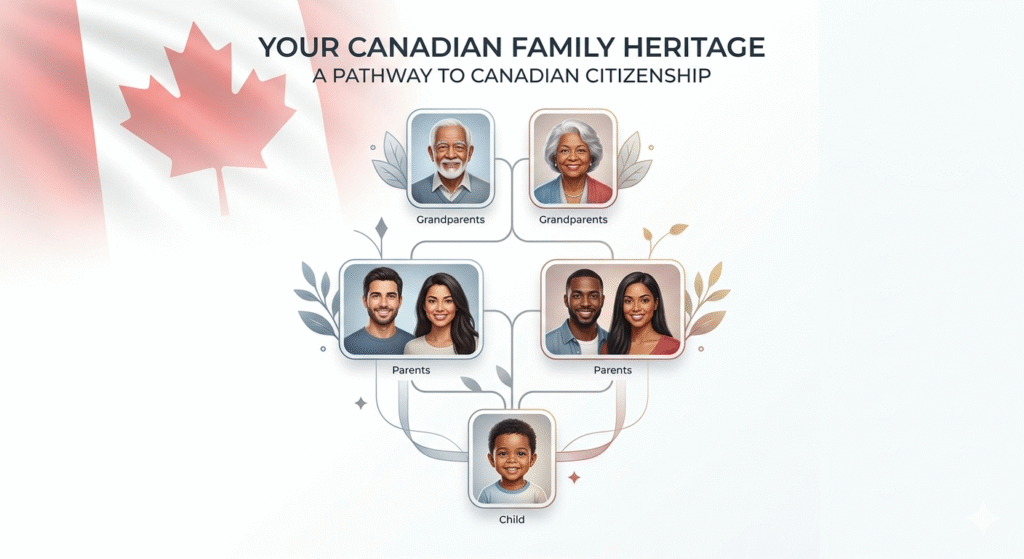
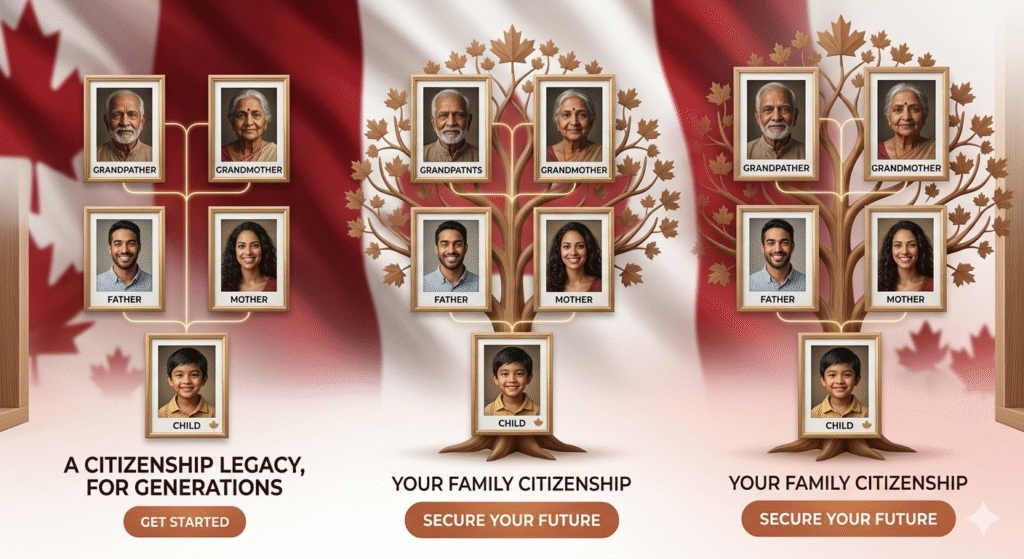
If you were born outside Canada and have a Canadian parent or grandparent, you should review your eligibility under Bill C-3.
You may already be Canadian.
At The Black Bear Canadian Immigration Consulting, we provide trusted guidance to help you confirm and document your citizenship status.
Whether you are recruiting talent or relocating to Canada, we support you throughout the entire process—from connecting with approved employers to managing your permanent residence application.

Email: contact@canadaforimmigration.com
Website: www.canadaforimmigration.com
WhatsApp: +1 (289) 221 8981
Office Phone: +1 (647) 948 8159
Explore our detailed presentation explaining the legal framework and strategic considerations behind Canada’s Humanitarian & Compassionate (H&C) pathway.
Our journey toward helping individuals and businesses migrate from the United States to Canada is strengthened through trusted collaborations and certified partners. Each logo below represents an organization, institution, or governmental body that supports or recognizes our commitment to legal, transparent, and efficient immigration pathways.

Introduction In a significant move, Quebec has issued invitations to workers in regulated professions as part of the Skilled Worker Selection...

Introduction In the most recent Express Entry draw, Immigration, Refugees and Citizenship Canada (IRCC) invited candidates from the Canadian Experience Class...
Introduction In a recent update from Immigration, Refugees and Citizenship Canada (IRCC), the third Express Entry draw of the week has...
A: Bill C-3 is a 2025 amendment to Canada’s Citizenship Act that came into effect on December 15, 2025. It removes the long-standing “first-generation limit” that previously prevented many people born outside Canada from claiming citizenship through their Canadian parents or grandparents. The law was introduced following a landmark 2023 Ontario Superior Court ruling that declared the old generational restriction unconstitutional. The result is a more inclusive citizenship framework that restores eligibility for thousands of people worldwide who were previously excluded.
A: The first-generation limit was a rule under the old Citizenship Act that generally stopped citizenship by descent after the first generation born outside Canada. This meant that if your Canadian parent was also born abroad, you were typically ineligible for citizenship — even if your family maintained strong ties to Canada. In December 2023, the Ontario Superior Court declared this rule unconstitutional. The federal government chose not to appeal, and instead introduced Bill C-3 to replace it with a fairer, more modern framework that recognizes globally mobile Canadian families.
A: Yes, this is one of the most important aspects of Bill C-3 — it has a retroactive effect. If you were born or adopted outside Canada in the second generation or later before December 15, 2025, you may have automatically become a Canadian citizen when the law came into force. This is not an immigration application process — it is a legal recognition of citizenship that already exists by operation of law. However, you still need to apply for a Citizenship Certificate to formally document and exercise that status, including applying for a Canadian passport.
A: The 1,095-day rule applies to children born or adopted outside Canada after December 15, 2025. Under this new “Substantial Connection” requirement, the Canadian parent must demonstrate at least 1,095 cumulative days — equivalent to three years — of physical presence in Canada before the child’s birth or adoption. This rule ensures that citizenship passed to future generations reflects a genuine and meaningful connection to Canada, while still preserving the ability for families to transmit citizenship across generations beyond the first.
A: Yes. Canadian citizenship is compatible with dual citizenship in many countries, including the United States. This makes Bill C-3 especially significant for Canadian-American families. Eligible individuals can hold both Canadian and U.S. citizenship simultaneously, gaining the legal right to live and work in Canada, access a Canadian passport, and benefit from cross-border mobility — all without giving up their U.S. citizenship. For families with Canadian ancestry living in the United States, this represents a major strategic opportunity.
A: Because citizenship by descent cases are highly technical, applications generally require a comprehensive evidentiary package. This typically includes multi-generational lineage verification, certified birth and adoption records for each generation, analysis of historical citizenship rules that applied at the time of each person’s birth, and — for post-2025 births — evidence of the parent’s substantial connection (1,095 days of physical presence in Canada). Incomplete or incorrect filings can lead to significant delays or outright refusals, so professional guidance is strongly recommended.
A: Confirming and documenting Canadian citizenship under Bill C-3 opens up a range of significant long-term advantages. These include the legal right to live and work anywhere in Canada, eligibility to apply for a Canadian passport, compatibility with dual citizenship in many countries including the U.S., the ability to pass citizenship to future generations under the new framework, and eventual access to Canada’s social systems subject to residency conditions. In an era of increasing global uncertainty, Canadian citizenship is widely viewed as a powerful strategic and personal asset.