Beyond the Border: 5 Crucial Realities for U.S. Citizens Considering Canada’s Humanitarian Pathway

Many U.S. citizens today are exploring Canada as a potential place of safety and long-term stability.

However, Canada’s Humanitarian and Compassionate (H&C) pathway is not a relocation shortcut — it is an exceptional legal measure governed by strict immigration law.

Understanding Canada’s Humanitarian & Compassionate (H&C) Pathway

Clear Legal Guidance for U.S. Citizens Exploring Canada’s Humanitarian Immigration Option

In recent years, the inquiries we receive at The Black Bear Canadian Immigration Consulting have shifted. We are increasingly hearing from U.S. citizens who feel a profound sense of uncertainty regarding their long-term safety and stability.

From political polarization and systemic instability to concerns over healthcare access and psychological stress, many are looking to Canada as a potential sanctuary.

However, the Humanitarian and Compassionate application under Section 25(1) of the Immigration and Refugee Protection Act (IRPA) is not a relocation program.

It is an exceptional legal measure designed only for individuals facing unusual and disproportionate hardship.

Black Bear Canadian Immigration Services

Why Many U.S. Citizens Explore This Pathway

Legal Entry Requirement

Applicants must first enter Canada legally before an H&C application can be considered.

Evidence-Based Hardship

Applicants must demonstrate unusual, undeserved, or disproportionate hardship.

Establishment in Canada

Strong ties within Canada significantly influence humanitarian decisions.

Immigration consultant meeting with clients

Black Bear Canadian Immigration Services

A Humanitarian Pathway Can Change Your Immigration Future

One carefully prepared humanitarian application can significantly influence a person’s immigration future.

However, success requires a structured legal strategy, documented evidence, and professional guidance.

Start your immigration assessment today and understand whether the H&C pathway may apply to your situation.

How the Humanitarian & Compassionate Process Works

Strategic Nomination Pathway – Tailored to Individual Circumstances

Each application is evaluated on the basis of documented hardship and establishment in Canada.

Key considerations include:

Legal entry into Canada (visitor, worker, or student)
Evidence development after arrival
Demonstrating unusual and disproportionate hardship
Establishment within Canadian society
Objective documentation including medical reports or psychological assessments

The Black Bear Canadian Immigration Consulting is ready to guide you.

Desk par passport, immigration forms, laptop

Black Bear Canadian Immigration Services

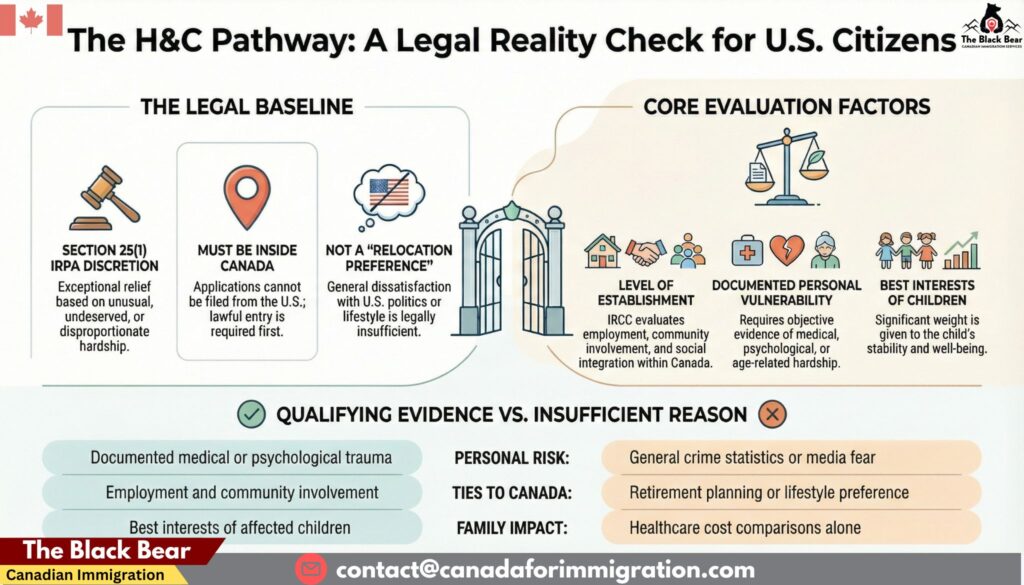
H&C Pathway: A Legal Reality Check for U.S. Citizens

Key legal requirements and evaluation factors used by Canadian immigration authorities when assessing Humanitarian & Compassionate applications.

Understanding Canada’s Humanitarian Immigration Pathway

Parent with Child in Safe Environment

Vulnerability & Best Interests of Children

Humanitarian applications carry the most weight when they involve documented vulnerabilities.

These may include:

Canadian immigration authorities must evaluate how removal from Canada may affect a child’s stability, development, and well-being.

Expert Immigration Insights

Listen to our immigration professionals discuss the realities of humanitarian immigration applications and the legal considerations involved.

Contact Us Now

Person holding a Canadian passport

Let’s Plan Your Canadian Future

The Black Bear Immigration Strategy Approach

Secure Your Immigration Strategy with Expert Guidance

At The Black Bear Canadian Immigration Consulting, we approach Humanitarian and Compassionate applications as a last-resort legal strategy, not a relocation shortcut.
Our process focuses on structured eligibility assessment, evidence development, and legal compliance to protect your long-term immigration future.

Why Choose The Black Bear Canadian Immigration

Customized Immigration Strategy

Every humanitarian case requires a unique legal assessment.

Evidence-Driven Applications

We focus on documentation that meets the legal threshold under IRPA Section 25(1).

Cross-Border Expertise

Extensive experience working with international clients navigating Canadian immigration law.

End-to-End Support

From eligibility assessment to application preparation.

Let’s Build Your Pathway

Whether you are recruiting talent or relocating to Canada, we support you throughout the entire process—from connecting with approved employers to managing your permanent residence application.


Email: contact@canadaforimmigration.com
Website: www.canadaforimmigration.com
WhatsApp: +1 (289) 221 8981
Office Phone:
+1 (647) 948 8159

Immigration Strategy Presentation

Explore our detailed presentation explaining the legal framework and strategic considerations behind Canada’s Humanitarian & Compassionate (H&C) pathway.

Latest News

Read Latest News

Our journey toward helping individuals and businesses migrate from the United States to Canada is strengthened through trusted collaborations and certified partners. Each logo below represents an organization, institution, or governmental body that supports or recognizes our commitment to legal, transparent, and efficient immigration pathways

  • All Post
  • Blog
  • Canada Work Permit
  • Featured
  • Immigration Tips
  • Inadmissibility
  • News Article
  • Study Permit
  • Uncategorized
  • Uncategorized
  • Uncategorized
  • USA To Cananda
Load More

End of Content.

Frequently Asked Questions

A: In most cases, U.S. citizens do not qualify for Canada’s humanitarian pathways simply because they are from the United States. Humanitarian and compassionate applications are usually reserved for people facing serious hardship, danger, or exceptional circumstances. Applicants must show strong reasons why they cannot safely remain in their current situation.


A: A Provincial Nominee Program (PNP) is an economic immigration program for workers, students, and skilled professionals. A humanitarian pathway is based on personal hardship or protection needs rather than work experience. Most U.S. citizens interested in moving to Canada are more likely to qualify through a PNP than through a humanitarian application.

A: Yes. A provincial nomination gives you 600 additional CRS points in Express Entry. This often allows candidates with lower original scores to receive an invitation for permanent residence through a PNP draw.

A: Provinces such as Ontario, British Columbia, Alberta, and Manitoba often invite candidates through their Provincial Nominee Programs. These provinces usually target workers in healthcare, technology, trades, and other in-demand occupations.

Q5: What situations may qualify someone for Canada’s humanitarian pathway?

A: Humanitarian and compassionate applications can take a long time to process. Current estimates are about 26 months outside Quebec and more than 50 months in Quebec. Processing times may continue to increase because of high demand.

A: Canada has announced new immigration pathways for certain groups in 2026, including temporary workers already in Canada and some U.S. H-1B visa holders. However, there is currently no special humanitarian pathway created specifically for all U.S. citizens.


Schedule a Free Assesment